
Static and dynamic material stresses acting on Ex "d" enclosures
DOI: 10.60048/exm20_38Testing ability to withstand pressure as per IEC 60079-1
Flameproof enclosures are certified in accordance with IEC 60079-1 [1]. For certification purposes, they must be subjected to certain testing, including of their ability to withstand pressure ([1] section 15.2). First, the reference pressure (the maximum pressure that is generated) during an explosion in the enclosure is measured. This value is used as the basis for overpressure testing.
Two different methods can be used for overpressure testing:
- Static: Static pressure is usually generated with water inside the enclosure, and the enclosure must withstand the pressure for at least 10 seconds. The following rules apply to production, depending on the test results:
- The enclosure withstands four times the reference pressure: There is no need to perform routine testing in production.
- The enclosure withstands three times the reference pressure: Routine batch testing must be performed.
- If the enclosure withstands less than three times the reference pressure, routine testing (100%) must be performed at 1.5 times the reference pressure.
- Dynamic: 1.5 times the reference pressure is generated by an explosion in the enclosure. One way of causing this is to pre-compress the combustion gas/air mixture in the enclosure.
If the enclosure and its joints have not undergone plastic deformation or sustained any damage, the test results are considered to be satisfactory.
The issue of equivalence
According to IEC 60079-1, the two overpressure test methods can be deemed equivalent. But do the two methods really subject the enclosure to the same stresses?
The static method subjects the enclosure to stress for much longer than the dynamic method, and no significant temperature differences arise between the interior of the enclosure and the enclosure itself.
With the dynamic method, the stress acts for a comparatively brief period, and the temperature inside the enclosure rises. This may result in the material behaving differently than it would at room temperature. Another, quite different effect also plays a significant role in the stresses that act on the material: An excess pressure phenomenon known as 'pressure piling' can result where there are components fitted inside an enclosure or where multiple enclosures are interconnected. These transient pressure spikes are caused by the compression of the uncombusted gas. Pressure may build up multiple times more quickly and may be multiple times higher than in enclosures without connecting pieces or fitted internal components [2, 3]. Besides the increased pressure, which can result in added demands when it comes to overpressure testing, there is also a chance that the enclosure will vibrate, placing another type of stress on the material.
In overpressure testing, only the reference pressure is used as the starting value. Studies have shown that considering the explosion pressure in isolation does not tell us much about the actual stresses acting on the material [4]. This begs the question of what variables actually influence the stresses on the enclosure material.
To ensure that their flameproof enclosures pass the overpressure tests, enclosure manufacturers generally design them to be oversized. If they had access to better information on how the enclosures behave during testing and why, they would be able to cut down on the amount of material used. This knowledge would enable manufacturers to produce more lightweight enclosures. Not only would less material be required, but transport costs – and the associated fuel consumption – would also fall. This is a sustainability objective worth pursuing.
Meassuring material stress
To answer the question of which of the tests on the enclosure is more critical, the individual material stresses acting on it must be considered. Usually, this means mechanical stress [5]. However, this cannot be measured directly during overpressure testing.
What can be measured directly during testing is the material's strain. For metals, the relationship between stress and strain is proportional up to the yield point/proof stress. The yield point/proof stress tells us the maximum stress/strain at which a material will still deform elastically [5].
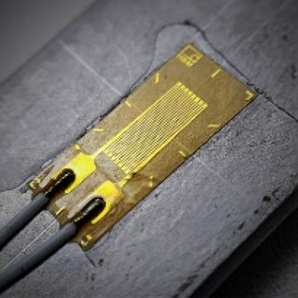
A material's strain can be measured using a tool called a 'strain gauge'. Strain gauges consist of one (linear strain gauges) or more (strain gauge rosettes) measuring grids.
Pressure-strain graphs
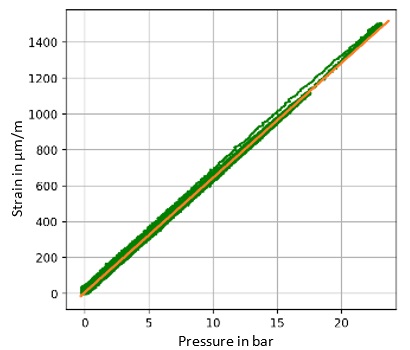
If you plot the material's strain against the pressure, the two variables behave proportionally to one another in the elastic deformation phase during static testing. This is illustrated in the figure on the left using 8-mm-thick structural steel as an example. A number of elastic tests were conducted, the results of which are represented here by a straight line that shows how a material of a certain thickness behaves.
Very similar pressure-strain graphs are obtained when enclosures undergo dynamic tests in the form of hydrogen/air explosions. The pressure and strain are proportional to one another in these graphs too.
If the material is plastically deformed by the water pressure, a degree of residual strain will remain permanently even after the stress is no longer acting on it.
In contrast to the above, if the geometry of the enclosure's interior is not simple, pressure piling may occur. In this scenario, there is no direct relationship between strain and pressure.
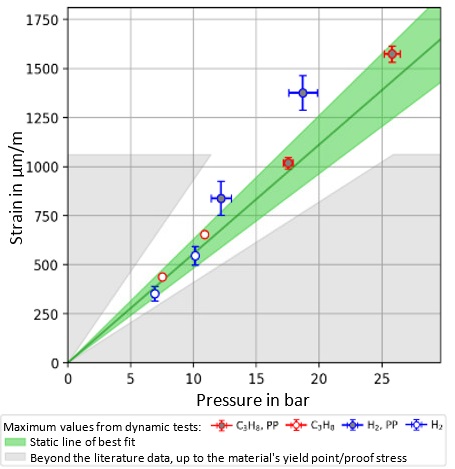
The figure on the left shows the line of best fit (green) for the results of a number of static tests on 8-mm-thick structural steel. For the dynamic tests, the maximum pressure and strain values are shown for propane/air (red) and hydrogen/air (blue) explosions. Some of these tests were performed in an enclosure in which pressure piling does not occur (points with white fill), and others were performed in an enclosure in which pressure piling does occur (points with grey fill).
According to the literature, the greyed-out area is not logical for the material being used. The upper border of this greyed-out area corresponds to the material's yield point/proof stress. As explained previously, the strain is proportional to the stress (material stress) up to this limit. Beyond this point, this is no longer the case, meaning that from here on, static testing and dynamic testing are not comparable. Below the limit, they are still comparable.
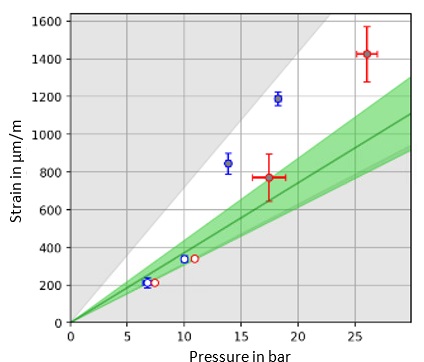
We can see that the results of the dynamic tests without pressure piling are in the vicinity of the straight line that reflects the static test results. This means that the material stress in these two test scenarios can be considered to be equivalent.
The opposite is true for dynamic tests where pressure piling occurs. In this scenario, given the same pressure, the maximum strain value is greater than in the static tests – the test methods are therefore not equivalent here.
This becomes clearer if you use aluminium as the enclosure material instead of structural steel. We can see the results in the figure on the left.
The dynamic tests with pressure piling (points with grey fill) have resulted in significantly higher strain values than the static tests at the same pressure.
Conclusion
According to IEC 60079-1, the static and dynamic overpressure test methods for testing flameproof enclosures can be deemed equivalent. But we have just seen that this is not always true. How this standard should be changed is not yet clear. To find out, further tests must be conducted in order to ascertain whether there are any differences above the yield point.
References
[1] DIN EN 60079-1:2015-04, section 15.2, 'Explosionsgefährdete Bereiche – Teil 1: Geräteschutz durch druckfeste Kapselung ”d“' ['Explosive atmospheres – Part 1: Equipment protection by flameproof enclosures "d"'] (IEC 60079-1:2014).
[2] Rogstadkjernet, L., 2004, 'Combustion of Gas in Closed, Interconnected Vessels: Pressure Piling', master's dissertation, Department of Physics and Technology, University of Bergen.
[3] Harcken, H., and Wehinger, H., 1985, 'Untersuchungen zur dynamischen Beanspruchung von Stahlgehäusen der Zündschutzart Druckfeste Kapselung' ['Investigations of dynamic stresses of steel flameproof enclosures'], techn. report PTB-W-24, 'Heat' division: PTB report.
[4] Krause, T., Bewersdorff, J., and Markus, D., Sep. 2017, 'Investigations of static and dynamic stresses of flameproof enclosures', Journal of Loss Prevention in the Process Industries 49.B, pp. 775-784. DOI: 10.1016/j.jlp.2017.04.015.
[5] Wittel, H., Jannasch, D., Voßiek, J., and Spura, C., 2019, Erratum: Strength calculation in Roloff/Matek Maschinenelemente [Roloff/Matek Machine Elements], Springer Vieweg, Wiesbaden. DOI: 10.1007/978-3-658-26280-8_49
[6] Licensed by Creative Commons Attribution 4.0 International, unaltered original, https://commons.wikimedia.org/wiki/File:Strain_gauge_-.jpg
[7] Spörhase, S., Brombach, F.M., Eckhardt, F., Krause, T., Markus, D., Küstner, B., and Walch, O., accepted for publication (expected 2022), 'Untersuchungen zur Vergleichbarkeit der statischen und dynamischen Überdruckprüfung von druckfesten Kapselungen' ['Investigations into the comparability of static and dynamic overpressure testing of flameproof enclosures'], Forschung im Ingenieurwesen [Research in Engineering]. ISSN: 0015-7899, 1434-0860. DOI: 10.1007/s10010-022-00604-z
More Article
Investigation of hydrogen generation in subsea umbilicals

In a growing number of cases, a build-up of hydrogen has been detected in the junction boxes located above the surface of the water, where…
Ex in sight
![[Translate to Englisch:]](/fileadmin/user_upload/magazin/artikel/20_27_Ex_im_Blick/1_Ex_im_Blick_Teaser.jpg "[Translate to Englisch:]")
Incorrect storage of hazardous chemical substances and inadequate surveillance of storage areas all too often result in catastrophic…
![[Translate to Englisch:]](/fileadmin/_processed_/f/f/csm_1_Baugruppen_II_Teaser_b6ad425dfd.jpg "[Translate to Englisch:]")
The Need for Integrated Project Management
Reducing project management and development time alone has the potential to deliver 15 to 30 percent in cost savings
Static and dynamic material stresses acting on Ex "d" enclosures
Flameproof enclosures must be subjected to certain testing, including of their ability to withstand pressure
PLP NZ celebrating 45 years with R. STAHL

45 years ago, three things came together, R. STAHL, PLP (Electropar Ltd), and the willingness to adopt innovative new hazardous area…
Emergency lighting
Central battery systems as emergency lighting systems offer secure protection in the event of a power supply failure
Sensing nonsense: When appearances are deceptive
Process engineering systems are generally controlled by measuring process variables such as temperature, pressure, quantity, fill level or…
Digital support for visual inspections using deep learning

The use of deep learning models offers huge potential for reducing the error rate in visual inspections. Smart object recognition enables…
Lightning and surge protection in intrinsically safe measuring…

According to Directive 1999/92/EC [1], the user or employer are obliged to assess the explosion hazard posed by their system and they must…
Ex assemblies, Part 1

The discussion about Ex assemblies is as old as the EU ATEX Directive, and now dates back almost 20 years
How R. STAHL TRANBERG is Meeting the Digitalization Demands of…

Digitalization and the integration of data and solutions is playing a pivotal role in the shipping and maritime industries today, having a…
The "PTB Ex proficiency testing scheme"

The "PTB Ex proficiency testing scheme" (PTB Ex PTS) is a project that involves developing interlaboratory comparison programmes to assess…
Non-electrical explosion protection
Manufacturers and users must acquire knowledge on the subject of non-electrical explosion protection, in order to assess the application,…
Certification in South Africa

Certification in South Africa has certain key differences from international certification, e.g. IECEx or ATEX
Global conformity assessment using the IECEx system
![[Translate to Englisch:]](/fileadmin/_processed_/c/e/csm_Einstiegsbild_IECEx_Paragraf_38414b50d0.jpg "[Translate to Englisch:]")
IEC Technical Committee (TC) 31, tasked with developing a global conformity assessment system for explosion-protected products
A mine of experience in industry
![[Translate to Englisch:]](/fileadmin/_processed_/f/f/csm_Einstiegsbild_e_tech_IEC_6270d7c66a.jpg "[Translate to Englisch:]")
He takes over from Thorsten Arnhold, who chaired the System for the past six years
Conformity assessment in the USA
In contrast to the international IEC/IECEx community and the European Union, the conformity assessment landscape in the USA is very…
25 Years of the Zone System in the USA
In the area of explosion protection, the publication of Article 505 in the 1996 National Electrical Code (NEC®) was seen as a giant step…
An Ex-citing future with hydrogen
![[Translate to Englisch:]](/fileadmin/_processed_/0/1/csm_shutterstock_1644506059_7d60f29da8.jpg "[Translate to Englisch:]")
Aside from a few exceptions based on the effect of gravitation and radioactivity, hydrogen is the source of most primary energy that makes…