

Emergency lighting
A brief overview
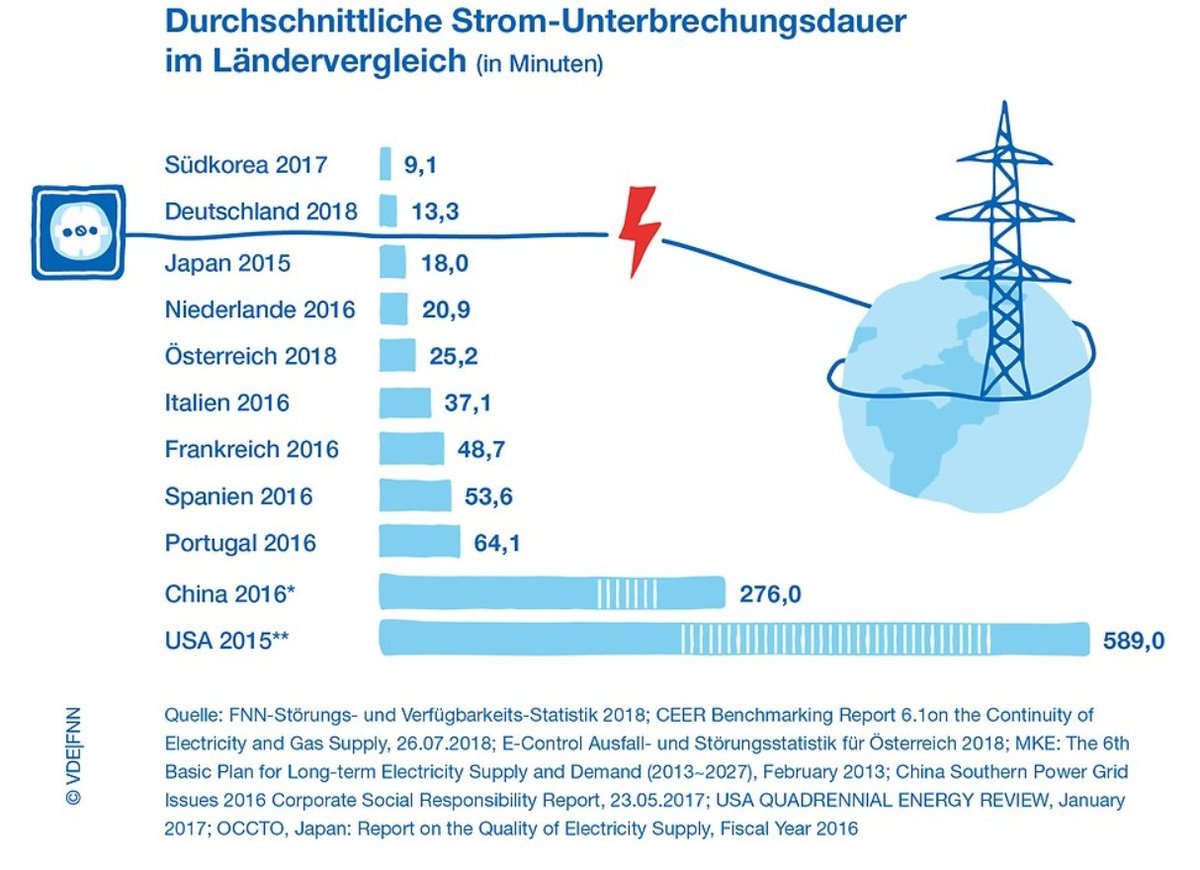
DOI: 10.60048/exm20_22Even Europe, as highly industrialised as it may be, is not extensively protected against power failures. The increased use of renewable energy sources and the associated fluctuations in supply mean that additional power supply issues may arise. As a result, a standby power supply is an absolute must, both in public spaces and at business premises.
Central battery systems as emergency lighting systems offer secure protection in the event of a power supply failure, safely providing the required lighting level even when the main supply network is unavailable.
The continued development of available, conventional technology and the introduction of new technologies in device engineering, as well as the integration of LEDs in emergency and rescue sign lighting have led to the creation of compact systems that go hand in hand with outstanding reliability.
Even in hazardous areas, integrating emergency luminaires into general lighting systems is common practice for cost reasons. When it comes to device engineering, this has resulted in particular challenges for programming emergency luminaires and for switching in conjunction with the light fittings in the general lighting system. This also generates higher electrical consumption, which affects the design of central battery systems.
When designing emergency lighting systems, various specifications and standards in construction law and occupational law, as well as EU specifications on lighting technology and electrical technology, apply. Specifications in standards apply to the standby power supply, batteries, light fittings, integrated electronic switches and recurring tests that cover all components integrated in the emergency lighting system.
The applicable standards requirements can be met in a number of ways. A particularly conservative approach, which may currently be practical for very small lighting systems, is to use self-supplied emergency luminaires. In this case, the energy storage is integrated directly into the light fitting. The other electronics contained in the light fitting must perform lighting function control, charge management for the battery and network monitoring, to enable fast switching to battery mode.
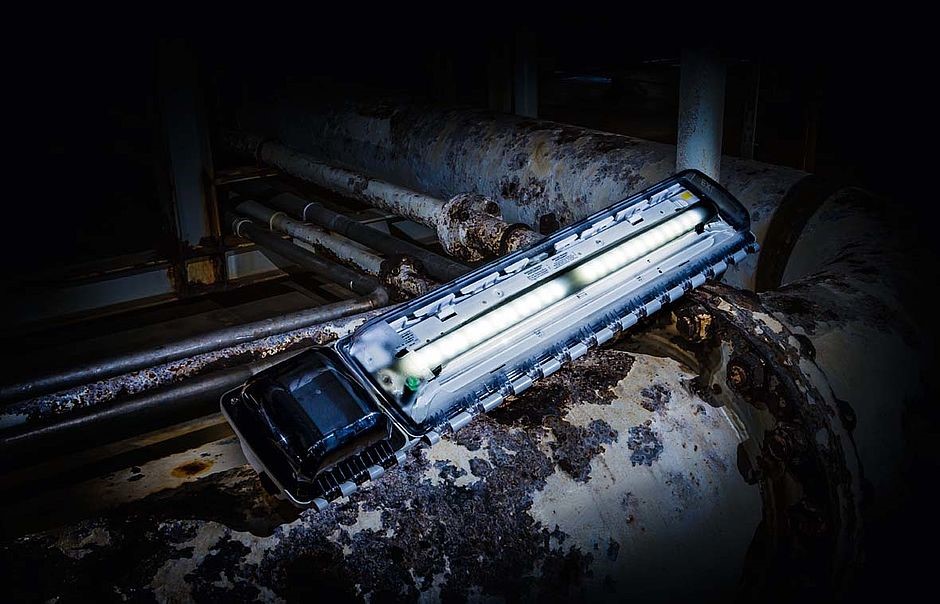
The electronics also fully automatically control the test function required according to standards (weekly test to check the emergency lighting function, annual test the check the prescribed battery capacity). To guarantee the function of emergency lighting in daily operation, the electronics are programmed so that the test is not performed simultaneously in all installed light fittings. An algorithm in the electronics ensures that the tests are started sequentially. This guarantees that only a small number of emergency luminaires are currently being tested at any time in case there is a network failure – the majority of luminaires are available and have sufficient battery power for use as emergency lighting.
An indicator lamp signals whether the light fittings are functioning correctly. One red LED and one green LED are enough to indicate all operating conditions of the light fittings clearly, visibly and unambiguously. Operators using lighting systems to illuminate workplaces are required by standards to check and document whether their emergency lighting is functioning correctly. The inspection book that is used must be shown in the event of a check by the inspection authority. In the case of large systems with multiple thousands of emergency luminaires, this can be a very time- and resource-intensive measure. The market therefore began looking for corresponding resource-friendly alternatives early on.
A standard-compliant central battery systems is the perfect alternative option. In this situation, all light fittings that are intended to perform a safety-related function are operated by a central control unit. The "normal operating network" and the "standby network" are thereby supplied via the same cable. The energy stores needed for emergency lighting operation are also positioned directly in the central battery system or, if the space or required battery capacity are needed, in a location that is spatially separated from the central unit. Switching between normal operation and battery operation takes place in the central unit.
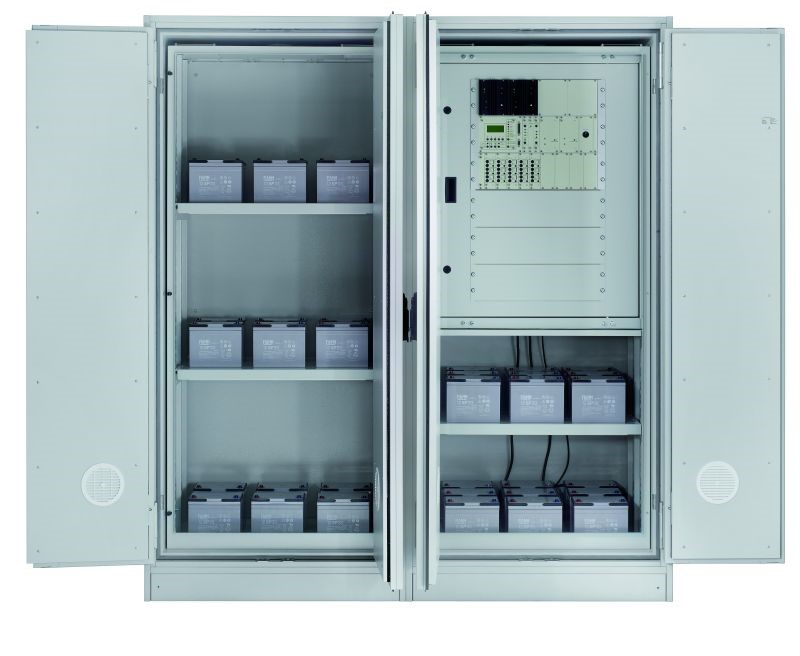
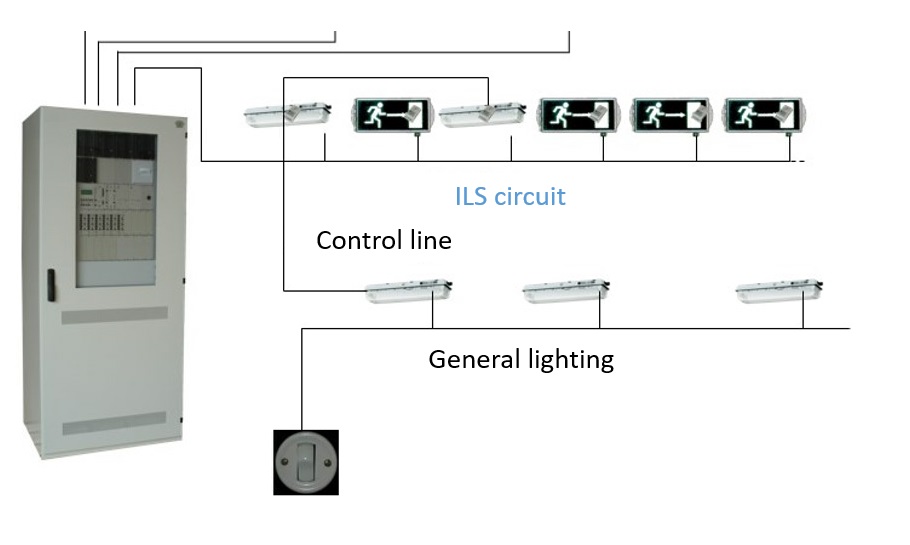
The battery tests required in standards are integrated into the system and are automatically started and saved in an internal digital inspection book. The data from the inspected emergency luminaires is also recorded in the inspection book. To query the status of a specific light fitting, communication must take place between the corresponding light fitting and the central unit. This occurs via "Power Line Communication" without the need for any additional cables. In practice, this means that the energy flow to the light fitting is modulated according to a communication signal. To establish this communication with a "normal emergency luminaire", an address module is integrated in the light fitting. The address module means that it is still possible to connect a light switch.
In order to comply with the standard, no physical interruption of the power supply is permitted between the central battery system and the light fitting itself. This requirement is based on the fact that any accidental interruption of the supply must be prevented. The switching signal from a switch is transmitted via the light fitting to the central unit. The central unit switches the light fitting according to the use. This ensures that the light fitting can be used normally as general lighting and guarantees that the emergency function is available.
As a result, an emergency lighting solution with a central battery system offers optimum operating convenience when it comes to operating the lighting system itself. Furthermore, the central battery system offers the user incredible savings potential with respect to the emergency lighting system as well. Instead of positioning the battery in the light fitting, which is exposed to the ambient conditions around the light fitting itself – ambient temperature, mechanical stress, moisture – the battery is placed in the battery cabinet or the central battery unit itself, most likely in an electrotechnology or EMSR team operating room. These operating rooms are usually air-conditioned to meet the needs of other technology in the room. This significantly extends the service life of the battery. What's more, battery replacement is performed in a safe area, rather than a hazardous area. One important advantage of central battery systems is based on the fact that the service life of the battery in the central battery system must be at least 10 years. A battery in a self-supplied light fitting must have a service life of at least 4 years, according to EN 60598-2-22. The maintenance cycle relevant for the user is therefore more than doubled in terms of time if a central battery system is used.
On the market, "uninterruptible power supplies" are often used instead of the somewhat more expensive central battery systems. In terms of their function, these provide a power supply for emergency luminaires with a corresponding supply voltage, even in the event of a network failure. However, these systems do not guarantee the standard-compliant check performed on the light fittings and the creation of an inspection book. This is where the central battery system comes in – ergonomic, efficient and cost-saving standard-compliant emergency lighting. STAHL offers systems of this type together with the associated planning services such as lighting design, emergency lighting design and TCO (total cost of ownership) calculations and is therefore able to supply optimum solutions to customers' problems in every respect.
More Article
LNG - The key energy source in the medium-term on the way to…

LNG stands for Liquefied Natural Gas and refers to natural gas that liquefies as it deep-cools to -162 °C and thereby shrinks to 1/600 of…
Competence and competencies in explosion protection

The field of explosion protection requires people who are able to respond competently, i.e. by choosing the correct course of action, in…

R. STAHL TRANBERG plays crucial role in world's first autonomous…
![[Translate to Englisch:]](/fileadmin/_processed_/2/8/csm_Yara_Bireland__Zero_Emission_d0e5ff95d4.jpg "[Translate to Englisch:]")
Remote control monitoring capabilities, situational awareness and resilience of R.STAHL TRANBERG’s navigation and search lighting key to…
The digital type plate in the era of Industry 4.0
![[Translate to Englisch:]](/fileadmin/_processed_/a/a/csm_Dig_Typenschild_Key_visual_quer_08c297ea4e.jpg "[Translate to Englisch:]")
A type plate contains essential information about a product, such as the manufacturer, product name and type, serial number and year of…
Power that never ends
![[Translate to Englisch:]](/fileadmin/_processed_/b/3/csm_Bild_13_USV_ADNOC_Offshore_Power_ohne_Ende_b07a7a5681.jpg "[Translate to Englisch:]")
Offshore platforms providing crude oil and natural gas require sufficient electrical energy in a continuous supply in order to guarantee…
Lithium-ion batteries for use in explosion protection
![[Translate to Englisch:]](/fileadmin/_processed_/b/c/csm_Lithium-Ionen_Akkus_Abbildung_7_3b0a489a32.png "[Translate to Englisch:]")
The advent of the digital revolution (industrial Internet of Things) has opened up new avenues for reducing costs and increasing system…
Explosion protection and digitalisation for automation

The digitalisation trend is showing no signs of slowing. The process automation sector is also working on this topic across a number of…